Nicodemus in the Bible was a Pharisee and member of the Jewish ruling council, the Sanhedrin, who appears only in the Gospel of John. He visited Jesus secretly by night (John 3:1–21), later defended Him before the council (John 7:50–51), and helped bury Him after the crucifixion (John 19:39). His story moves from cautious curiosity to courageous devotion.

Nicodemus is one of the most fascinating minor figures in the New Testament. John introduces him as “a ruler of the Jews” (John 3:1) — a respected Pharisee, a teacher of Israel, and a man of wealth and influence. Yet this powerful religious leader came to Jesus under cover of darkness, carrying questions he could not ask in daylight.
Perhaps you know the feeling. You have questions about faith that seem too basic, too doubtful, or too risky to voice out loud. Nicodemus shows us that Jesus welcomes midnight questions. What began as a secret conversation became one of the most quoted passages in all of Scripture — for it was to Nicodemus that Jesus first spoke the words of John 3:16.
In this guide, you will meet Nicodemus across all three of his Gospel appearances, understand what “you must be born again” really means, discover what happened to him after the crucifixion, and find honest answers to the most-asked questions about his life and legacy.
Who Was Nicodemus?
Nicodemus was a Pharisee — a member of the strict religious party devoted to the Law of Moses — and a member of the Sanhedrin, the seventy-one-member Jewish ruling council in Jerusalem. John 3:1 calls him “a ruler of the Jews,” and Jesus later calls him “Israel’s teacher” (John 3:10), suggesting he was a widely recognized religious scholar.
His wealth is evident from his final appearance: at Jesus’ burial he brought about seventy-five pounds of myrrh and aloes (John 19:39), an extravagant gift only a rich man could afford. His Greek name, meaning “victory of the people,” hints that his family belonged to the Hellenized upper class of Jerusalem.

The Night Visit: Nicodemus Meets Jesus (John 3:1–21)
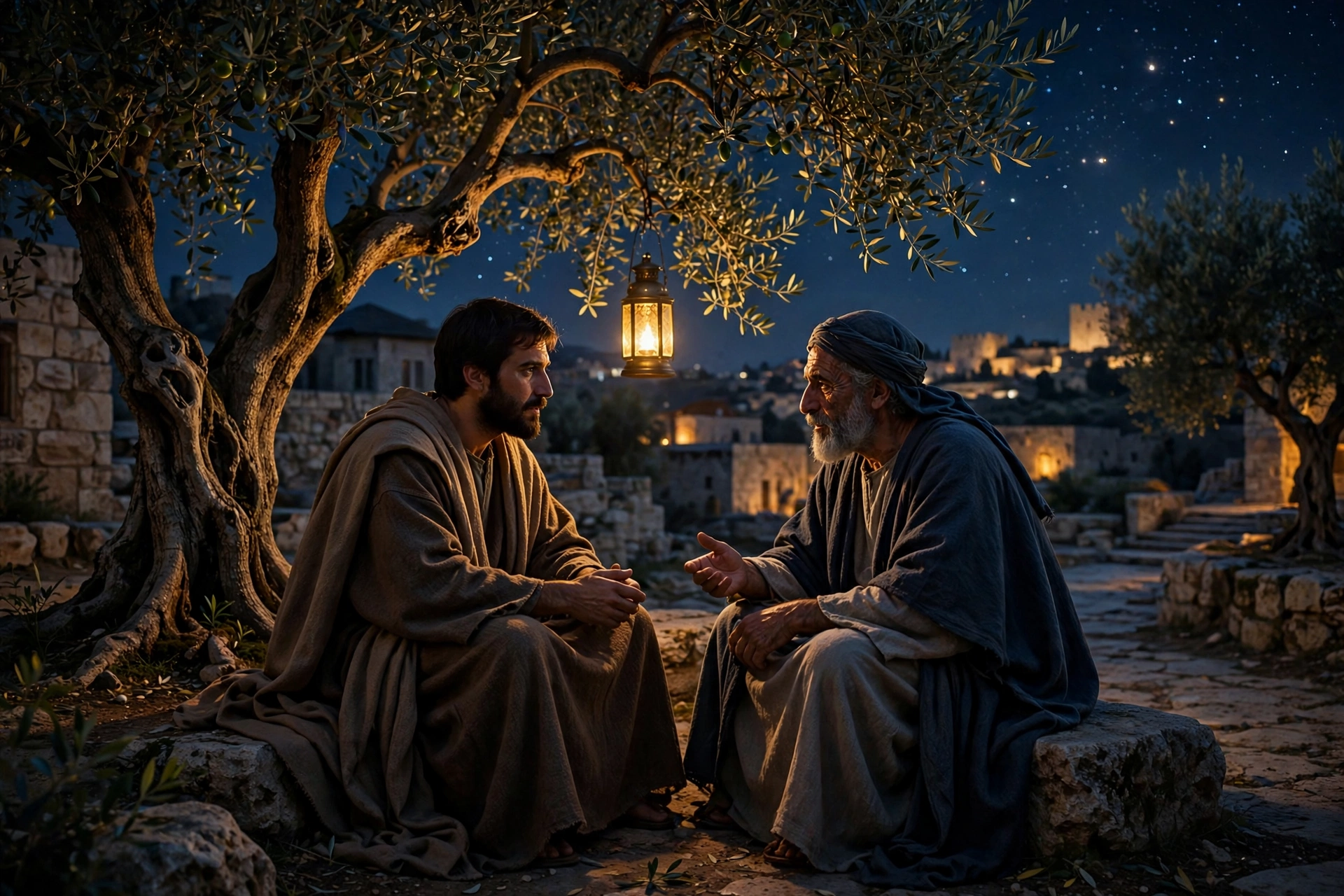
“He came to Jesus at night” (John 3:2). Why the secrecy? Scripture does not say directly, but he most likely feared what his fellow Pharisees would think. John 12:42–43 notes that many Jewish leaders believed in Jesus but would not confess it “for fear they would be put out of the synagogue.” Nicodemus came with respect — “Rabbi, we know that you are a teacher who has come from God” — but also with caution.
Jesus answered with one of the most startling statements in the Gospels: “Very truly I tell you, no one can see the kingdom of God unless they are born again” (John 3:3). Nicodemus, thinking literally, asked how an old man could re-enter his mother’s womb. Jesus explained He meant a spiritual birth — being “born of water and the Spirit” (John 3:5).

“You Must Be Born Again”: What Jesus Meant
The Greek word Jesus used, anothen, means both “again” and “from above.” Nicodemus heard only “again” and was confused; Jesus meant a birth that comes from above — a work of God’s Spirit, not human effort. As Jesus put it, “Flesh gives birth to flesh, but the Spirit gives birth to spirit” (John 3:6).
Then came the verse the world would never forget. Speaking to this midnight visitor, Jesus said: “For God so loved the world that he gave his one and only Son, that whoever believes in him shall not perish but have eternal life” (John 3:16). The most famous verse in the Bible was first spoken in a quiet nighttime conversation with a questioning Pharisee — and Jesus added that God did not send His Son to condemn the world, but to save it (John 3:17).
Nicodemus Defends Jesus (John 7:50–51)
Nicodemus appears a second time when the chief priests and Pharisees sent officers to arrest Jesus. When the officers returned empty-handed, the Pharisees were furious — and Nicodemus, “who had gone to Jesus earlier and who was one of their own number,” spoke up: “Does our law condemn a man without first hearing him to find out what he has been doing?” (John 7:50–51).
It was a measured, legal defense — not yet an open confession of faith, but a real risk. His colleagues mocked him: “Are you from Galilee, too?” (John 7:52). The man who once came by night was now speaking up in daylight, before the very council that opposed Jesus.
Nicodemus at the Burial of Jesus (John 19:38–42)
After the crucifixion, Nicodemus appears a third and final time — and this time there is no hiding. Joseph of Arimathea asked Pilate for Jesus’ body, and “Nicodemus brought a mixture of myrrh and aloes, about seventy-five pounds” (John 19:39). Together they wrapped the body with the spices in strips of linen and laid it in a new tomb.
Seventy-five pounds of burial spices was a kingly amount — a fortune poured out in grief and honor. The secret seeker had become a public mourner. Whatever Nicodemus believed, he was no longer afraid to be seen beside Jesus.
What Does the Name Nicodemus Mean?
The name Nicodemus comes from the Greek Nikodemos, combining nike (“victory”) and demos (“people”) — “victory of the people.” It was a common Greek name, which fits a family of standing in Jerusalem’s Hellenized upper class.

There is a quiet irony in the name: the man called “victory of the people” first sought Jesus in secret, away from the people — yet his story ends in a kind of victory, as he steps into the open at the cross.
Did Nicodemus Become a Follower of Jesus?
The Bible never states it outright, and honest readers should admit that. But the trajectory is striking: from a night visit (John 3), to a daylight defense (John 7), to a public, costly act of devotion at the burial (John 19). Each appearance shows a bolder man.
Early church tradition held that Nicodemus did become a believer — some accounts say he was baptized and later suffered for his faith — though these traditions cannot be verified from Scripture. What the Gospel shows us is enough: a religious insider drawn step by step out of darkness into the light.
Lessons From Nicodemus for Today
Nicodemus reminds us that honest questions are welcome. Jesus did not scold him for coming at night; He answered with the deepest truths of the Gospel. If you carry doubts or fears about faith, bring them to Jesus — even at midnight.
He also shows that spiritual growth is often gradual. Courage came to Nicodemus in stages. If your faith feels small or secret today, take the next step you can — speak one true word, do one brave deed — and trust God with the rest. If fear has kept your faith quiet, prayers for protection can help you bring those anxieties to God, and Monday morning prayers for strength can steady you for the week ahead.

For more portraits of Bible figures who met God in unexpected ways, explore our Bible character studies, including the story behind the name Atticus in Scripture.
Frequently Asked Questions About Nicodemus
Who was Nicodemus in the Bible?
Nicodemus was a Pharisee, a member of the Sanhedrin (the Jewish ruling council), and “a ruler of the Jews” (John 3:1). He appears only in the Gospel of John — visiting Jesus by night (John 3), defending Him before the council (John 7:50–51), and helping bury Him (John 19:39).
Why did Nicodemus visit Jesus at night?
Scripture does not say directly, but he likely feared the reaction of his fellow Pharisees. John 12:42–43 explains that many Jewish leaders believed in Jesus yet stayed silent for fear of being expelled from the synagogue. Night offered privacy for honest questions.
What does “born again” mean in John 3?
Jesus told Nicodemus, “You must be born again” (John 3:7) — or “born from above.” He meant a spiritual rebirth by God’s Spirit, not a physical second birth: “Flesh gives birth to flesh, but the Spirit gives birth to spirit” (John 3:6). It is God’s work received through faith, not human achievement.
Why did Jesus say John 3:16 to Nicodemus?
John 3:16 — “For God so loved the world that he gave his one and only Son” — was spoken during the night visit as the climax of Jesus’ teaching on the new birth. To a religious leader trusting in law-keeping, Jesus revealed that eternal life comes through believing in God’s Son.
Did Nicodemus become a disciple of Jesus?
The Bible does not say explicitly. But his three appearances show growing boldness: a secret night visit, a public legal defense, and finally an open, costly act of devotion at the burial. Many readers see a man moving step by step toward faith.
What happened to Nicodemus after Jesus died?
Scripture records nothing about Nicodemus after the burial in John 19. Later church traditions claim he was baptized and suffered persecution for his faith, but these accounts come from outside the Bible and cannot be verified.
How did Nicodemus help bury Jesus?
After Joseph of Arimathea received Pilate’s permission to take Jesus’ body, Nicodemus brought about seventy-five pounds of myrrh and aloes. Together they wrapped Jesus’ body with the spices in strips of linen and laid Him in a new tomb (John 19:39–42).
What does the name Nicodemus mean?
Nicodemus is a Greek name meaning “victory of the people,” from nike (victory) and demos (people). Its Greek form suggests his family belonged to the Hellenized upper class of Jerusalem.
Was Nicodemus a Pharisee and a member of the Sanhedrin?
Yes. John 3:1 identifies him as both: “a Pharisee” and “a member of the Jewish ruling council” — the Sanhedrin. Jesus also calls him “Israel’s teacher” (John 3:10), marking him as a respected religious scholar.
What can we learn from Nicodemus today?
Nicodemus teaches us to bring honest questions to Jesus without shame, to let courage grow in stages, and to move from private curiosity to public faithfulness. His journey from night to daylight reminds us that no seeker is too late and no question too small for Christ.
Conclusion
Nicodemus came to Jesus by night with the careful questions of a religious professional — and left with the greatest promise ever spoken: “For God so loved the world…” (John 3:16). Across three brief appearances, John paints a portrait of a man slowly, bravely stepping out of the shadows.
His story is an invitation. Whatever hour of the night you find yourself in, Jesus will meet you there. Come with your questions, stay for the truth, and walk — step by step — into the light.

I’m Emma, an AI content writer with 4 years of experience creating heartfelt prayers, Bible-based messages, blessings, and inspiring faith-filled content.