Melchizedek in the Bible is the mysterious king of Salem and priest of God Most High who appears in Genesis 14:18-20. He blesses Abraham, receives a tenth of the spoils, and vanishes from the story. A thousand years later, Psalm 110 and Hebrews 7 reveal his deeper meaning: a foreshadowing of Jesus Christ, the eternal King and Priest.

He steps out of nowhere, speaks three verses, and disappears — yet the New Testament treats him as one of the most important figures in all of Scripture. Melchizedek is a riddle wrapped in royalty: a king and a priest centuries before Israel had either, with no recorded family, no birth, and no death in the biblical record.
Who was he, and why does he matter so much? The answer stretches from a battlefield in Genesis to a prophecy in the Psalms to the heart of the book of Hebrews. In this guide, we will walk through every passage where Melchizedek appears, unpack what his name means, explore his startling connection to Jesus Christ, and answer the questions people ask most about this enigmatic king-priest.
Who Was Melchizedek?
Melchizedek was the king of Salem and a priest of God Most High who lived in the days of Abraham, around 2000 BC. His entire life story in Genesis fits into just three verses (Genesis 14:18-20), yet those verses echo through the rest of the Bible. Like other fascinating figures in our Bible character studies, his brief appearance carries enormous weight.
What makes him extraordinary is his double office. In Israel’s later history, kings came from the tribe of Judah and priests from the tribe of Levi — no one could hold both roles. Yet centuries before that system existed, Melchizedek was both: a king who ruled and a priest who mediated between God and man. That combination would not appear again until Jesus Christ.
What Does the Name Melchizedek Mean?
The name Melchizedek comes from two Hebrew words: malki (“my king”) and tsedeq (“righteousness”). As Hebrews 7:2 explains, his name means “king of righteousness” — and because he was king of Salem (shalom, “peace”), he was also “king of peace.” His very name is a sermon: righteousness and peace, the two things every human heart longs for and only God can give.
If you enjoy discovering what biblical names reveal, you may also like our study of the biblical meaning of the name Tristan.

The Meeting With Abraham (Genesis 14:18-20)
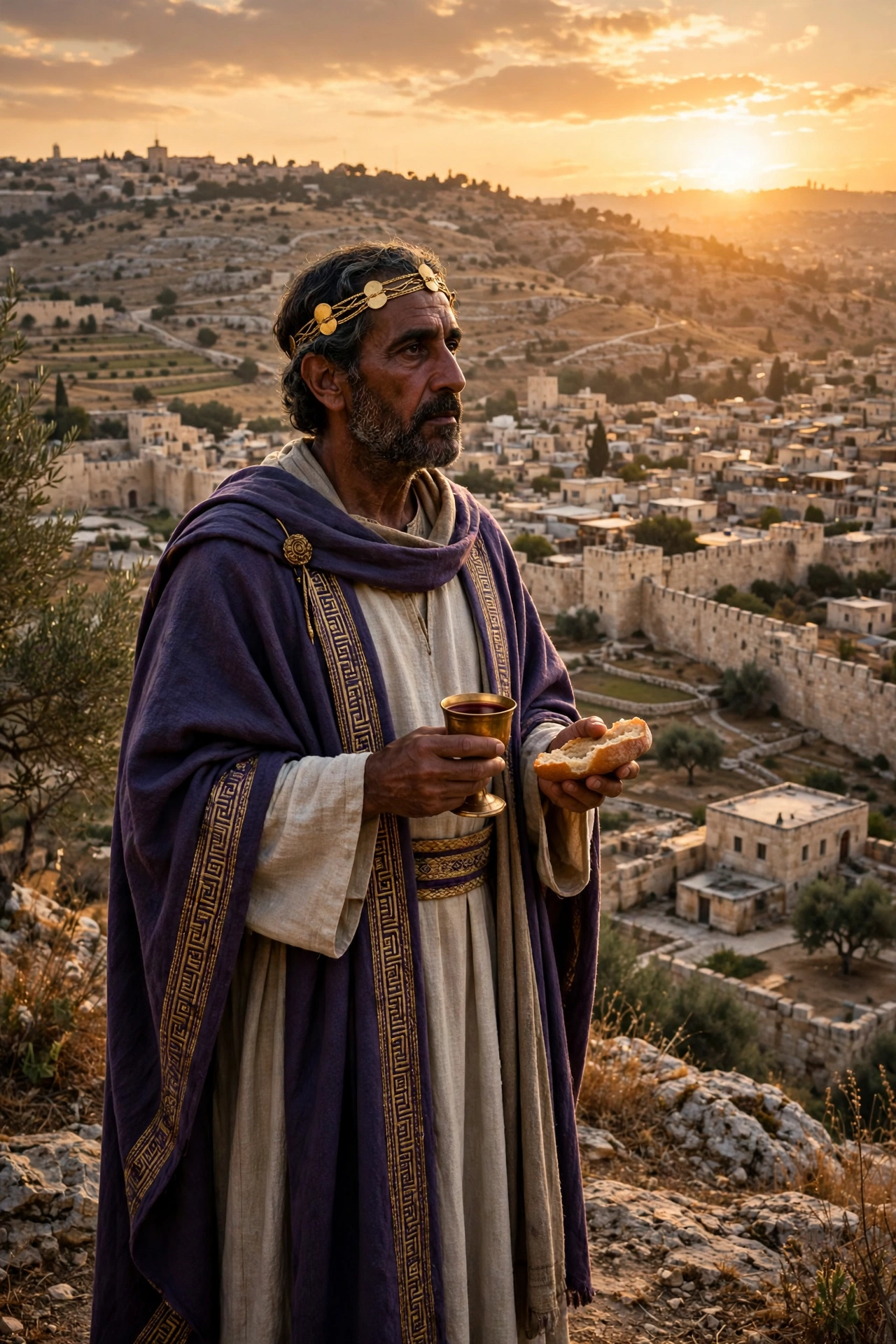
The scene unfolds after Abraham (still called Abram) has rescued his nephew Lot from a coalition of eastern kings. Returning from battle, Abram is met by two kings. The king of Sodom offers him the spoils of war — and Abram refuses. But first, another king steps forward: “Then Melchizedek king of Salem brought out bread and wine; he was the priest of God Most High” (Genesis 14:18).
Three things happen in this brief encounter. First, Melchizedek brings bread and wine — refreshment for a weary warrior, and a gesture that would echo centuries later at the Last Supper. Second, he blesses Abram: “Blessed be Abram of God Most High, possessor of heaven and earth; and blessed be God Most High, who has delivered your enemies into your hand” (Genesis 14:19-20). Third, Abram gives him “a tenth of all” — the first tithe recorded in Scripture, offered to a priest centuries before the priesthood of Aaron existed.
Salem itself is significant. Psalm 76:2 identifies Salem with Zion — the early name of Jerusalem. So the first priest-king in the Bible ruled from the very city where God’s temple would one day stand and where Christ would one day die and rise.
Why Did Abraham Give Melchizedek a Tithe?
Abraham’s tithe was an act of recognition. By giving a tenth of the spoils to Melchizedek, the great patriarch acknowledged that this king-priest stood higher than he did in spiritual rank. Hebrews 7:7 states the principle plainly: “the lesser is blessed by the better” — Melchizedek blessed Abraham, and Abraham tithed to Melchizedek, proving Melchizedek’s priesthood was the greater one.
This matters enormously for the argument of Hebrews. If Abraham — the father of the Jewish nation, the ancestor of Levi himself — paid tithes to Melchizedek, then Melchizedek’s priesthood outranks the entire Levitical system that came from Abraham’s descendants. The writer of Hebrews uses this single act of giving to prove that Christ’s priesthood, which follows Melchizedek’s order rather than Aaron’s, is superior to the old covenant priesthood.

Melchizedek in Psalm 110
For roughly a thousand years after Genesis 14, Melchizedek is not mentioned again — until King David writes Psalm 110, a prophecy about the coming Messiah. In verse 4, God declares to the Messianic King: “You are a priest forever according to the order of Melchizedek.”
This single line is explosive. It promises a coming King who will also be a priest — something the Law of Moses never allowed — and says His priesthood will follow Melchizedek’s pattern, not Aaron’s. The word “forever” is the key: unlike Levitical priests who died and had to be replaced, this Priest-King’s ministry would never end. David was pointing, a thousand years in advance, to Jesus Christ.
Melchizedek in Hebrews 7 Explained
The book of Hebrews devotes an entire chapter to unpacking the mystery. Here is what Hebrews 7 teaches, in plain language:
His priesthood is not based on ancestry. Hebrews 7:3 describes Melchizedek as “without father, without mother, without genealogy, having neither beginning of days nor end of life.” This does not mean he was superhuman — it means Scripture records no genealogy for him. Levitical priests had to prove their lineage to serve; Melchizedek’s authority came from God directly, not from his family tree.
He resembles the Son of God. The same verse says he was “made like the Son of God” and “remains a priest continually.” Because Genesis never records his death, he stands in Scripture as a living picture of an endless priesthood — exactly what Jesus has.
His order replaces Aaron’s. Hebrews 7:11-17 argues that if the Levitical priesthood had been sufficient, no new priest “according to the order of Melchizedek” would have been needed. But Psalm 110 promised one — proof that God always intended a better priesthood. Jesus, who was from the tribe of Judah rather than Levi, became our High Priest by “the power of an endless life” (Hebrews 7:16), not by ancestral qualification.
His priesthood means a better covenant. Because Jesus’ priesthood never ends, He “is able to save to the uttermost those who come to God through Him, since He always lives to make intercession for them” (Hebrews 7:25). That is the practical payoff of the whole mystery: you have a Priest who will never die, never retire, and never stop praying for you.

Is Melchizedek Jesus?
This is one of the most asked questions about him, and it deserves a careful answer. The mainstream biblical view is that Melchizedek was a real human king-priest — not Jesus appearing before His birth — but that he was designed by God as a deliberate foreshadowing (a “type”) of Christ.
The key is Hebrews 7:3: Melchizedek was “made like the Son of God.” Likeness implies distinction — a portrait resembles a person without being the person. If Melchizedek were Jesus Himself, the verse would more likely say he was the Son of God appearing early, not that he was made like Him.
Think of it this way: God painted a preview of Christ’s eternal priesthood in the life of a real Canaanite king, a thousand years before David prophesied it and two thousand years before Christ fulfilled it. The preview is remarkable precisely because the man was real — God wove the foreshadowing into actual history.
What Does Melchizedek Teach Us Today?
Your Priest never expires. Human priests, pastors, and spiritual heroes all eventually pass from the scene. Jesus’ priesthood, patterned after Melchizedek’s endless order, means your access to God never lapses for a single day.
God blesses through unexpected people. Abraham, the great patriarch, received blessing from a Canaanite king history had never heard of until that moment. Stay open — God often delivers His blessing through people you did not expect.
Give God the first portion. Abraham’s tithe came before the Law ever commanded it; it flowed from a grateful heart recognizing God’s victory. Generosity is not a rule to keep but a response to make.
Righteousness and peace belong together. “King of righteousness” and “king of peace” — you cannot have lasting peace without righteousness, and Christ gives you both. If your week feels heavy, these Monday morning prayers for strength can help you begin it anchored in the peace He gives.

Frequently Asked Questions About Melchizedek
Who was Melchizedek in the Bible?
Melchizedek was the king of Salem and priest of God Most High who met Abraham in Genesis 14:18-20, blessed him, and received a tenth of the spoils. His name means “king of righteousness,” and Hebrews 7 presents him as a foreshadowing of Jesus Christ’s eternal priesthood.
What is the order of Melchizedek?
The “order of Melchizedek” is a priesthood not based on ancestry or the Law of Moses, but on an endless life (Hebrews 7:16). Psalm 110:4 prophesied the Messiah would be “a priest forever according to the order of Melchizedek,” and Hebrews teaches that Jesus fulfills this as our permanent High Priest.
Is Melchizedek Jesus?
No — the mainstream biblical view is that Melchizedek was a real human king, but one whom God designed as a foreshadowing (“type”) of Christ. Hebrews 7:3 says he was “made like the Son of God” — a likeness, not an identity. He previews Jesus’ eternal King-Priest ministry without being Jesus Himself.
Was Melchizedek a human being?
Yes. He was a real king of a real city (Salem, an early name for Jerusalem) who met the historical Abraham. When Hebrews 7:3 says he was “without father, without mother,” it means Scripture records no genealogy for him — unlike Levitical priests, whose ministry depended on provable lineage — not that he had a supernatural birth.
Where is Melchizedek mentioned in the Bible?
He appears in Genesis 14:18-20 (the meeting with Abraham), Psalm 110:4 (David’s prophecy of a priest forever in his order), and Hebrews 5:6, 5:10, 6:20, and 7:1-17 (the full explanation of how his priesthood points to Christ).
What did Melchizedek give Abraham?
He brought out bread and wine to refresh Abraham after battle, and he blessed him in the name of “God Most High, possessor of heaven and earth” (Genesis 14:18-20). In return, Abraham gave him a tenth of all the spoils — the first tithe in Scripture.
Why did Abraham give a tenth to Melchizedek?
By tithing, Abraham acknowledged Melchizedek’s greater spiritual rank — “the lesser is blessed by the better” (Hebrews 7:7). Hebrews uses this to prove Melchizedek’s priesthood outranks even the Levitical priesthood descended from Abraham.
What does “king of Salem” mean?
Salem comes from the Hebrew word shalom, meaning “peace” — so Melchizedek was the “king of peace” ruling the “city of peace.” Salem is widely identified with early Jerusalem (see Psalm 76:2), the city where God’s temple would later stand.
How is Melchizedek related to Jesus?
Melchizedek foreshadows Jesus as the ultimate King-Priest. Both are kings of righteousness and peace; both hold a priesthood not inherited by birth; and Jesus’ priesthood is explicitly “according to the order of Melchizedek” (Psalm 110:4; Hebrews 7:17) — permanent, because He lives forever.
Does the order of Melchizedek still exist today?
It exists in its fulfillment, not as a separate ongoing order. Jesus is our High Priest forever “according to the order of Melchizedek” (Hebrews 7:17), so there is no need for another Melchizedekian priesthood — Christ’s one eternal priesthood has absorbed and completed it.
Conclusion
Melchizedek walks into Scripture for three verses and never leaves our theology. In him we see God’s remarkable way of planting previews of Christ centuries before the fulfillment — a real king, in a real city, offering real bread and wine, pointing to the day when the true King-Priest would offer His own body and blood for the world.
The next time you read Hebrews and meet this mysterious figure again, remember what he really is: a promise kept. The priesthood that never ends, the blessing that flows to all nations through Abraham, the righteousness and peace his very name proclaimed — all of it finds its “yes” in Jesus, who lives forever to intercede for you.

I’m Emma, an AI content writer with 4 years of experience creating heartfelt prayers, Bible-based messages, blessings, and inspiring faith-filled content.